The History of the IQ Test: From Eugenics to BuzzFeed Quizzes
FakeIQ Staff
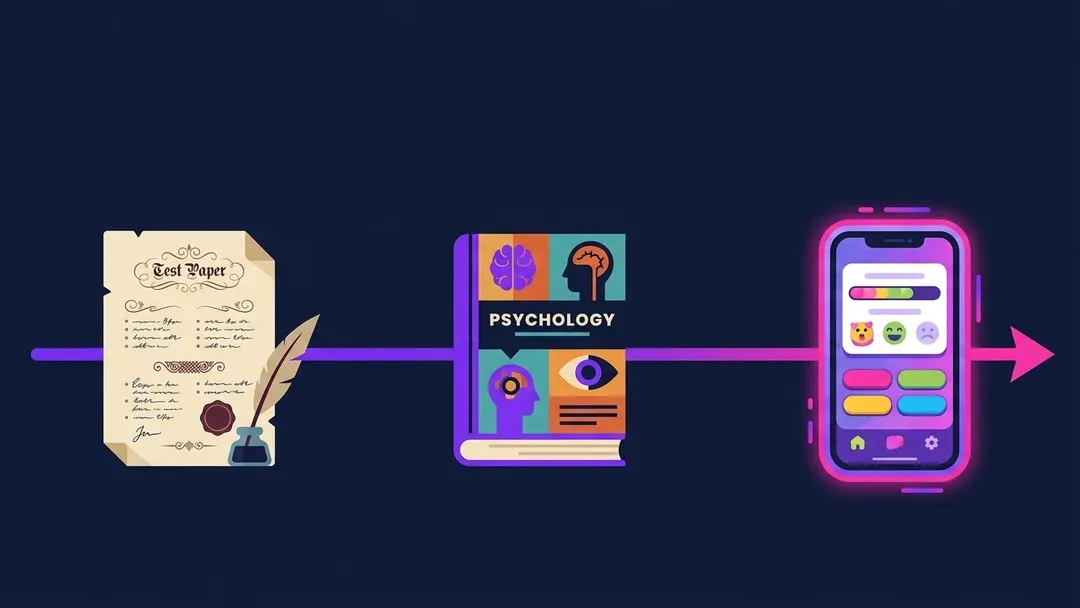
The IQ test has one of the wildest origin stories in all of science. It starts with a well-intentioned French psychologist, takes a dark turn through American eugenics, survives a near-death experience during the civil rights movement, and somehow ends up as a BuzzFeed quiz that tells you which Disney princess matches your intelligence level.
Buckle up. This is going to get weird.
Act I: Paris, 1905 — A Modest Proposal
Our story begins with Alfred Binet, a French psychologist with a simple problem. The French government had just passed a law requiring all children to attend school, and they needed a way to identify kids who might struggle and need extra support.
Binet and his colleague Theodore Simon designed a test. It was a series of tasks arranged by difficulty: remembering numbers, following simple instructions, identifying differences between objects. The idea was to figure out a child’s “mental age” — if a seven-year-old could only complete tasks that most five-year-olds could handle, they might benefit from additional help.
This is important: Binet’s test was diagnostic, not deterministic. He explicitly said the test didn’t measure innate intelligence. He warned against using it to rank people. He wrote that intelligence was too complex to be captured by a single number. He was, in many ways, the first person to articulate exactly why IQ scores are misleading.
Nobody listened.
Act II: America, 1910s — Enter the Eugenicists
The test crossed the Atlantic and landed in the hands of Henry Goddard, an American psychologist who had… different ideas about what to do with it. Goddard translated Binet’s test into English and started using it to classify people — not to help them, but to sort them.
Goddard was a eugenicist. He believed that intelligence was hereditary, fixed at birth, and distributed unequally across races and social classes. He used IQ tests at Ellis Island to screen immigrants, and — surprise — found that most non-English-speaking immigrants scored poorly on his English-language test. He published these results as evidence of racial intellectual hierarchies.
Then came Lewis Terman at Stanford, who revised the test into the “Stanford-Binet” — the version that introduced the modern IQ score formula (mental age divided by chronological age, multiplied by 100). Terman was also a eugenicist. He wrote in 1916 that “the whole question of racial differences in mental traits will have to be taken up anew” using IQ testing, and predicted that testing would reveal “enormously significant racial differences in general intelligence.”
This wasn’t fringe science at the time. This was mainstream American psychology. The test designed to help struggling schoolchildren was being used to justify forced sterilization programs, immigration restrictions, and racial segregation.
Act III: The Army Tests and the Rise of Mass Testing
World War I gave IQ testing its biggest platform. The U.S. Army needed to sort 1.7 million recruits quickly, so psychologist Robert Yerkes convinced the military to administer intelligence tests to all of them. The Army Alpha test was for literate recruits; the Army Beta was for illiterate ones (which, in practice, meant many Black soldiers and recent immigrants).
The results were predictable: white, native-born, English-speaking recruits scored highest. Rather than questioning whether the test was biased, the scientific establishment accepted the results as confirmation of existing racial hierarchies.
These results were then used by the political establishment. The Immigration Act of 1924 — which severely restricted immigration from Southern and Eastern Europe — cited Army test data as evidence that these populations were intellectually inferior. The data wasn’t just interpreted incorrectly; it was weaponized.
Act IV: Mid-Century — The IQ Test Gets a Makeover
By the 1940s and 1950s, the explicitly eugenicist framework was falling out of fashion (it turns out that Nazis using your science to justify genocide is bad for your brand). The IQ test needed a rebrand.
Enter David Wechsler, who developed the Wechsler Adult Intelligence Scale (WAIS) in 1955. Wechsler’s innovation was to break intelligence into multiple subscales — verbal comprehension, perceptual reasoning, working memory, and processing speed — rather than collapsing everything into a single number. He also normalized scores against the population, setting the average at 100 with a standard deviation of 15.
This was a genuine improvement. The WAIS acknowledged that intelligence wasn’t monolithic. It gave clinicians more nuanced information. It was better calibrated and more carefully validated.
But the public only cared about one thing: the composite number. Your IQ. The single score. The label. Despite Wechsler’s more sophisticated approach, the cultural conversation stayed locked on the same question: what’s your number?
Act V: The Bell Curve and the Culture Wars
In 1994, Richard Herrnstein and Charles Murray published “The Bell Curve,” a book arguing that IQ differences between racial groups were partly genetic. The book became a cultural firestorm, and the IQ test was once again at the center of a debate about race, intelligence, and social policy.
The scientific response was mostly condemnation. The American Psychological Association convened a task force that concluded there was no evidence for genetic explanations of racial IQ gaps, and that environmental factors (poverty, education access, test bias) were sufficient explanations. But the damage was done — the IQ test was once again publicly associated with racial pseudoscience.
This is the paradox of the IQ test: every time the scientific community tries to rehabilitate it as a legitimate clinical tool, someone uses it to make claims about racial hierarchies, and the whole thing collapses into controversy again. The test itself isn’t the problem. The problem is what people do with the numbers.
Act VI: The Flynn Effect — IQs Are Going Up?
In the 1980s, James Flynn noticed something strange: IQ scores had been rising steadily across the developed world, about 3 points per decade, for as long as reliable data existed. This meant that someone who scored 100 (average) in 1980 would have scored about 115 if tested against 1950 norms.
This is called the Flynn Effect, and it created an uncomfortable question: are people actually getting smarter, or are IQ tests measuring something that changes over time?
The answer seems to be “a bit of both, but mostly the latter.” Better nutrition, more education, greater familiarity with abstract thinking (the kind of reasoning IQ tests emphasize), and even the cognitive demands of modern technology have all been proposed as explanations. The Flynn Effect basically proves that IQ scores aren’t measuring some fixed, innate capacity — they’re measuring performance on a specific test, and that performance is influenced by environment.
Recent data suggests the Flynn Effect may be reversing in some countries. IQ scores in Norway, Denmark, and Finland have been declining since the 1990s. This has been blamed on everything from screen time to educational changes to environmental toxins. It’s probably a mix of factors, but the key point remains: IQ scores are not stable across time, which means they’re not measuring what most people think they’re measuring.
Act VII: The BuzzFeed-ification of Intelligence
And now we arrive at the present. The IQ test has been repackaged, trivialized, and scattered across the internet in forms that Binet would find unrecognizable. “Find Out Your REAL IQ In Just 10 Questions!” “Only Geniuses Can Score 8/10 On This Quiz!” “This Color Test Will Reveal Your IQ!”
These tests measure nothing. They’re engagement bait, designed to make you click, feel good (or indignant) about your score, and share the result. They have no psychometric validity. They’re the intellectual equivalent of a fortune cookie — except fortune cookies don’t pretend to be science.
But in a weird way, these fake tests are the logical endpoint of a century of IQ fetishism. We wanted intelligence to be a number so badly that we created an entire industry around giving people numbers. The numbers are meaningless, but the desire for them is real. When you look at those celebrity IQ scores floating around the internet, you’re seeing the same impulse: please, just give me a number I can compare.
The Moral of the Story
The IQ test started as a modest tool to help children. It was hijacked by eugenicists, weaponized against immigrants and minorities, briefly rehabilitated as a clinical instrument, dragged back into racial pseudoscience, and finally reduced to clickbait.
Through it all, the test itself has mostly stayed the same — a series of tasks measuring specific cognitive abilities under specific conditions. What’s changed is how we interpret the results, and how much weight we put on a single number.
If there’s a lesson here, it’s this: the problem was never the test. The problem is our obsession with ranking, categorizing, and simplifying human intelligence into something that fits on a scoreboard. Binet knew this in 1905. We’re still figuring it out.
And in the meantime, you can always take our Fake Genius Test and find out which optical illusions break your brain. At least we’re honest about being pointless.