The Most Useless Facts Your Brain Will Refuse to Forget
FakeIQ Staff
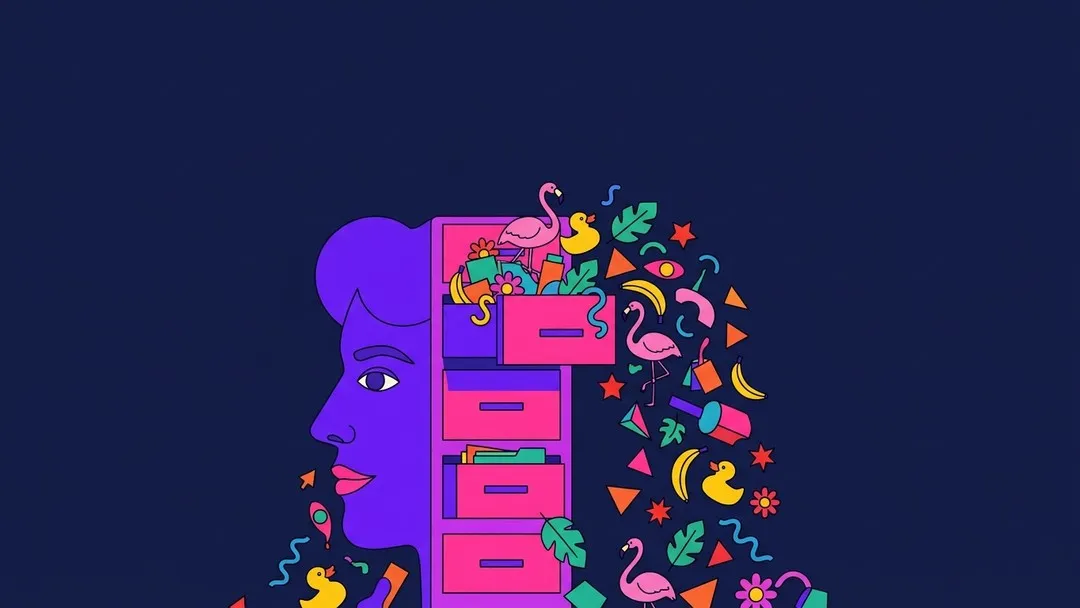
Your brain has approximately 86 billion neurons, capable of forming trillions of connections, and it uses about 20% of your body’s total energy. It can compose symphonies, solve differential equations, and navigate complex social hierarchies with remarkable precision.
It also absolutely refuses to let go of the fact that a group of flamingos is called a “flamboyance.”
We’re going to fill your head with facts you didn’t ask for, don’t need, and will never be able to un-learn. Consider this your weekly dose of cognitive clutter. You’re welcome.
Animals Being Ridiculous
A group of flamingos is called a “flamboyance.” We already told you this one, but now you’ve read it twice, so it’s really in there. Other magnificent collective nouns: a “parliament” of owls, a “conspiracy” of lemurs, a “flamboyance” of flamingos (worth repeating), and a “murder” of crows. English is a very normal language.
Cows have best friends and get stressed when separated. Researchers at the University of Northampton found that cows show measurably lower stress responses when they’re housed with their preferred companion. They also show increased heart rates when they’re isolated from their buddy. Your cheeseburger had a social life.
Octopuses have three hearts, blue blood, and nine brains. One central brain and one mini-brain in each arm. When an octopus loses an arm, the arm continues to react to stimuli for up to an hour. It can grab food and try to bring it to where the mouth would be, except the mouth isn’t there anymore. The arm doesn’t know it’s been severed. This is either fascinating or deeply upsetting, depending on your relationship with calamari.
Wombats poop cubes. Their intestines have varying elasticity that shapes their droppings into roughly cubic forms. Scientists believe this prevents the droppings from rolling away, which matters because wombats use their poop to mark territory. They’ve essentially evolved Lego bricks for communication purposes. A team at Georgia Tech won an Ig Nobel Prize for figuring out how this works.
The mantis shrimp can punch at the speed of a .22 caliber bullet. Their strike is so fast it creates cavitation bubbles in the water — tiny vacuum pockets that collapse with enough force to produce light and temperatures approaching the surface of the sun. For a fraction of a nanosecond. Every time a mantis shrimp punches a snail. The snail, presumably, does not appreciate this.
History Being Weird
Oxford University is older than the Aztec Empire. Teaching existed at Oxford as early as 1096. The Aztec Empire was founded in 1428. By the time the Aztecs were building Tenochtitlan, Oxford had been running for over 300 years and had probably already established a confusing college system and several pubs.
Cleopatra lived closer in time to the Moon landing than to the construction of the Great Pyramid. The Great Pyramid was built around 2560 BCE. Cleopatra lived around 30 BCE. The Moon landing was in 1969 CE. The pyramid predates Cleopatra by about 2,530 years; the Moon landing came only about 2,000 years after her death. Ancient Egypt was so ancient that even ancient Egyptians thought it was ancient.
Nintendo was founded in 1889. They made playing cards. The Ottoman Empire still existed. Queen Victoria was on the throne. It would be 83 years before they made their first video game. If you told a Nintendo card factory worker in 1889 that one day their company would make a plumber jump on turtles in a fictional mushroom kingdom, they would have had you committed.
The fax machine was invented before the telephone. Alexander Bain patented the “Electric Printing Telegraph” (essentially a fax machine) in 1843. Alexander Graham Bell patented the telephone in 1876. The fax machine predates the phone by 33 years. It also somehow managed to remain the dominant form of medical record transmission until approximately 2019.
Science Being Unsettling
There are more possible iterations of a game of chess than there are atoms in the observable universe. The Shannon number estimates about 10^120 possible chess games. There are roughly 10^80 atoms in the observable universe. This means that the game you played badly against your uncle at Thanksgiving was, statistically speaking, a unique event in the history of the cosmos. It was still a bad game, though.
You are 10% human. By cell count, your body contains roughly 38 trillion bacteria and 30 trillion human cells. The bacteria outnumber you. You are, technically, a cooperative colony with a sense of self. This is either a profound meditation on the nature of identity or a very good reason to wash your hands, depending on your philosophical inclination.
Bananas are radioactive. They contain potassium-40, a naturally occurring radioactive isotope. You’d need to eat roughly 10 million bananas at once to die from radiation poisoning. This is not a recommendation. The “banana equivalent dose” is actually used as an informal unit of radiation exposure by nuclear engineers. Smart people have definitely used this fact to sound clever at parties.
Honey never expires. Archaeologists have found 3,000-year-old honey in Egyptian tombs that was still perfectly edible. Honey’s low moisture content, high acidity, and production of hydrogen peroxide make it essentially immortal. The honey in your cupboard will outlast your cupboard, your house, and statistically speaking, you.
The human brain named itself. This isn’t strictly a science fact, but think about it for a second. The brain is the only organ that named itself. It also decided it was the most important organ. Using itself. This is the neurological equivalent of reviewing your own performance and giving yourself a raise.
Language Being Absurd
“Buffalo buffalo Buffalo buffalo buffalo buffalo Buffalo buffalo” is a grammatically correct sentence in English. It means: “Buffalo from Buffalo, New York, that are intimidated by other Buffalo from Buffalo, New York, themselves intimidate other Buffalo from Buffalo, New York.” This is the kind of thing that makes non-native English speakers stare blankly and then choose to learn Spanish instead.
The dot over a lowercase ‘i’ or ‘j’ is called a “tittle.” You now know this forever. It will surface unbidden in conversations for the rest of your life. You’ll want to share it. People will not be as impressed as you hope.
“Set” has the most definitions of any English word — over 430 in the Oxford English Dictionary. A set of dishes, to set a bone, the sun sets, a set in tennis, set theory, mindset, set aside, set up, set off. English basically let one word do the jobs of about fifty words because it was too lazy to make new ones.
There is a word for the day after tomorrow: “overmorrow.” It’s archaic English, but it’s real. German has “ubermorgen.” Why English abandoned this perfectly useful word is one of the great minor tragedies of linguistic history. “See you overmorrow” is a much better text message than “see you the day after tomorrow.”
Numbers Being Suspicious
If you shuffle a deck of 52 cards properly, the resulting order has almost certainly never existed before in history and will never exist again. 52 factorial (52!) is approximately 8 x 10^67. Even if every person on Earth shuffled a deck once per second since the beginning of the universe, we wouldn’t have come close to exhausting the possibilities. Your last card game was cosmically unprecedented.
1 is not a prime number. It used to be. Mathematicians kicked it out. Before the 20th century, many mathematicians considered 1 prime. Then they rewrote the definition specifically to exclude it because including 1 broke the Fundamental Theorem of Arithmetic. Math said “the rules don’t work if we include you” and 1 said nothing because it’s a number.
Why Your Brain Keeps This Stuff
Here’s the thing that actually matters: your brain stores these facts not because they’re useful, but because they’re surprising. The hippocampus — the brain region crucial for forming new memories — responds strongly to novelty and emotional arousal. Weird facts hit both triggers. They’re unexpected, and they produce a tiny jolt of amusement or disbelief.
This is the same mechanism that makes brain teasers sticky in your memory. When you get tricked by a puzzle, your brain encodes not just the answer but the emotional experience of being wrong. That’s why you remember the Monty Hall problem years later even if you can’t remember what you had for lunch yesterday.
So congratulations. You’ve just permanently loaded about two dozen utterly useless facts into your long-term memory. They will surface at parties, in job interviews, and at 3 AM when you should be sleeping. Your brain will refuse to delete them.
You’re welcome. And if you want to test whether any of this knowledge makes you a “genius”, we have a very official-looking test that will tell you absolutely nothing. Which, when you think about it, is the most honest IQ test on the internet.